 +31(0)884321800
 en
 nl


27 national frameworks ≠ 27 separate compliance processes
In Part 3 of our Textile EPR series: Textile EPR Europe: which countries have implemented textile EPR?, we give an overview of where requirements already apply and how they differ per country.
Why does a decentralized approach fall short?
Because requirements are national, many organizations start by letting local subsidiaries or country managers arrange their own registrations and reporting to Producer Responsibility Organizations (PROs), formerly often referred to as compliance schemes.
That feels logical. But in Part 5 of our Textile EPR series: Textile EPR roadmap: where should your organization start?, we explain why decentralized compliance is one of the most common pitfalls. In practice, it often leads to:
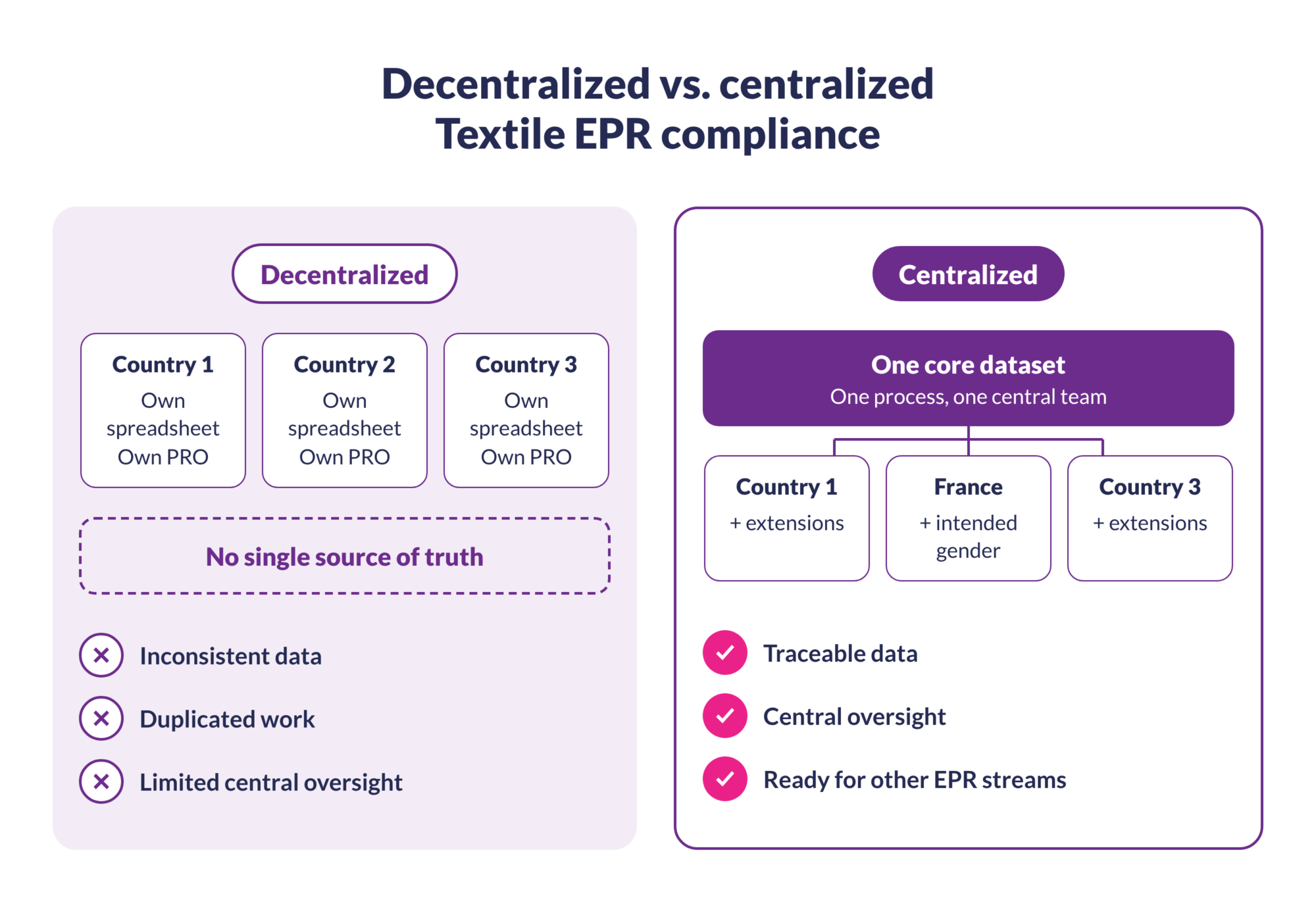
- Inconsistent data: One country may ask for total net weight and material composition, while another asks for item-level CN codes or a breakdown by gender. When local teams each work in their own spreadsheets, the data they report can contradict each other.
- Duplicated work: Each country team interprets changing legislation on its own. That costs time and increases the risk of errors.
- Limited central oversight: Without a single source of truth, management has no clear view of total EPR fees across Europe, upcoming reporting deadlines or exposure to enforcement measures. Depending on the country and applicable legislation, these can include financial penalties and restrictions on placing products on the market.
4 steps to organize compliance across multiple countries
To keep the European Clothing, Linen & Footwear (CLF) landscape manageable, you need to move from separate local efforts to one coordinated, multi-country approach.
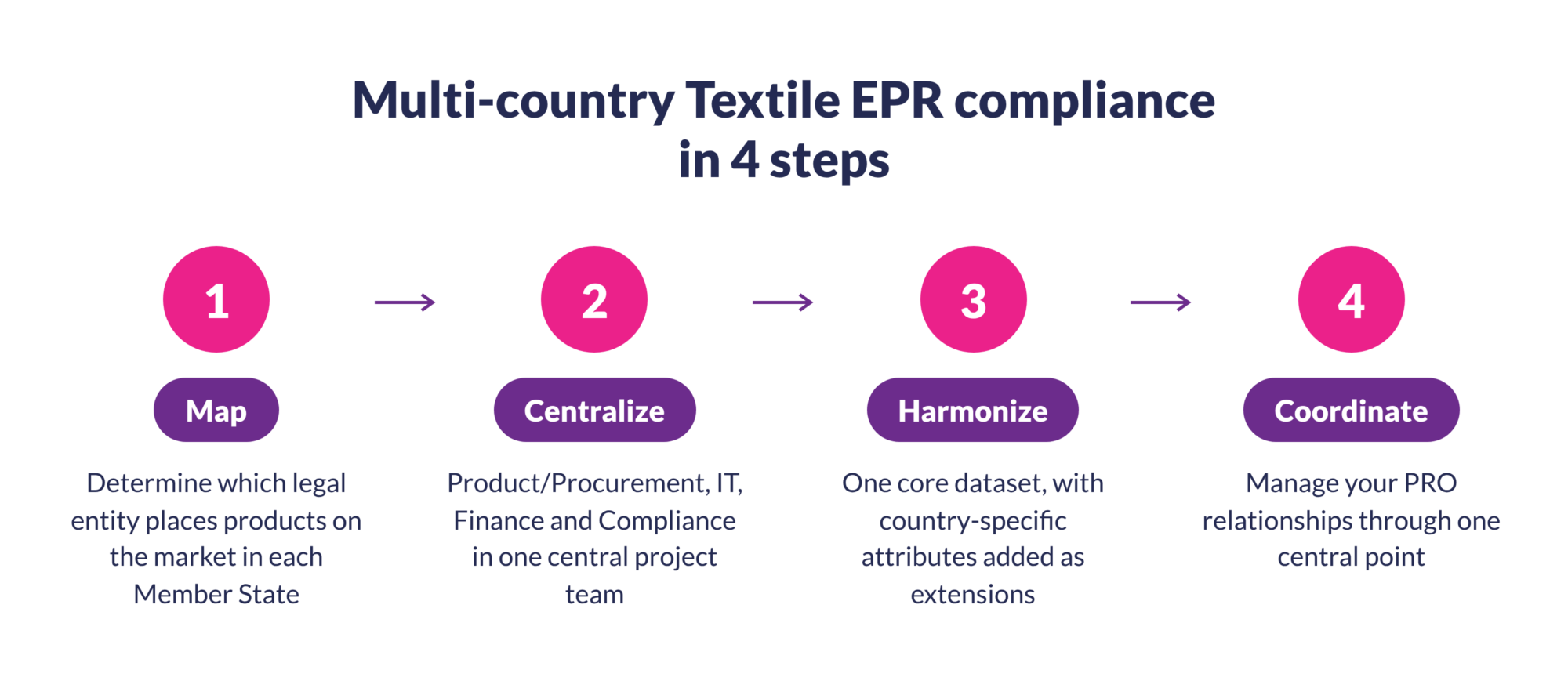
- Map your obligations per country: Determine which legal entity places products on the market in each Member State. Your role in the supply chain can differ per country. You may be the importer in one country, the manufacturer in another and a distance seller in a third. In Part 2 of our Textile EPR series: Textile EPR producer: when are you considered a producer?, we explain how to determine your role.
- Set up a central project team: Bring together Product/Procurement, IT, Finance and Compliance at headquarters. This team owns the overall strategy, monitors regulatory updates across countries and sets the data collection rules for all subsidiaries.
- Harmonize your master data: Treat your product data as one shared asset, with one standardized data structure that is managed centrally. When a country requires specific attributes, such as the intended gender in France, add them as a reporting extension to your core dataset instead of building a separate file.
- Coordinate your PRO selection: Working with different PROs in multiple countries can quickly become time-consuming and fragmented. Managing your PRO relationships through one central point makes contract management and fee forecasting easier.
PRACTICAL LESSON Centralize the foundation, not the legislation.
Use one core dataset and one process for all countries, and add country-specific requirements where needed.
This is the same principle we described in Part 1 of our Textile EPR series: Textile EPR implementation: 3 common pitfalls organizations should avoid.
How one centralized approach reduces risk
A centralized European approach changes your risk profile in two ways.
- Traceable data: When data is validated centrally, every figure you submit to national authorities and PROs can be traced back to its source. This can reduce the risk of reporting errors, overpaid fees or underreporting, and the penalties that may follow.
- Ready for other EPR streams: A central data foundation for Textile EPR can also support other EPR streams, such as packaging under the PPWR, WEEE and Batteries. Each stream has its own requirements, but the same master data structure can be reused. In Part 4 of our Textile EPR series: Textile EPR and the PPWR: which compliance obligations apply to you?, we explain how these frameworks relate.
What does this mean for your organization?
More Member States will introduce Textile EPR in the run-up to 17 April 2028. Each new country brings its own requirements, deadlines and PROs. If every country is handled separately, the workload grows with every market you add. With one central structure, a new country means adding its specific requirements to what you already have.
Use these questions to check where you stand:
- Obligations: Do you know which legal entity places products on the market in each Member State, and in which role?
- Ownership: Is there one central team that owns the strategy and monitors regulatory updates across countries?
- Data: Do you work from one core dataset, or does each country team keep its own spreadsheet?
- PROs: Do you have a central view of your PRO contracts, fees and reporting deadlines?
2028 is the deadline, not the starting point. Building one central structure now gives your organization room to add new countries as their requirements take effect.
What can Pincvision do for you?
Managing Textile EPR in multiple countries does not mean you have to build a large internal compliance department. We turn separate country-level CLF obligations into one centralized process:
- We map which obligations apply to your organization, in which countries and for which legal entities.
- We help structure your product and sales data in our automated reporting system.
- We manage recurring reports across countries on your behalf and monitor legislation, adjusting the process where needed.
This gives you one centralized approach to Clothing, Linen & Footwear (CLF) compliance across Europe, while your team stays focused on its core business. It also creates a solid foundation for other Extended Producer Responsibility streams, such as packaging (PPWR), WEEE and Batteries.
Selling Clothing, Linen & Footwear in multiple European countries and unsure how to organize your compliance?
Get in touch. We'll help you set up one central approach that meets the requirements of each country. ⬇️
 3 min
Michelle Myburgh
Environmental Compliance Specialist


