 +31(0)884321800
 en
en
 nl
nl


Earlier in this series, we covered the most common implementation pitfalls, explained when you are considered a producer, mapped where Textile EPR already applies across Europe and showed how data requirements overlap between Textile EPR and the PPWR. This article answers the next question: where should your organization actually start?
2028 is the deadline, not the starting point. Waiting for the 2028 deadline of the Waste Framework Directive before taking action puts you under pressure: you risk missing deadlines and facing enforcement measures. Building a reliable, international Textile EPR compliance process does not happen overnight. It requires a structured, step-by-step roadmap that aligns your internal teams, data and legal obligations.
1 Producer status → 2 Project team → 3 Data → 4 Countries & PROs → 5 Automation
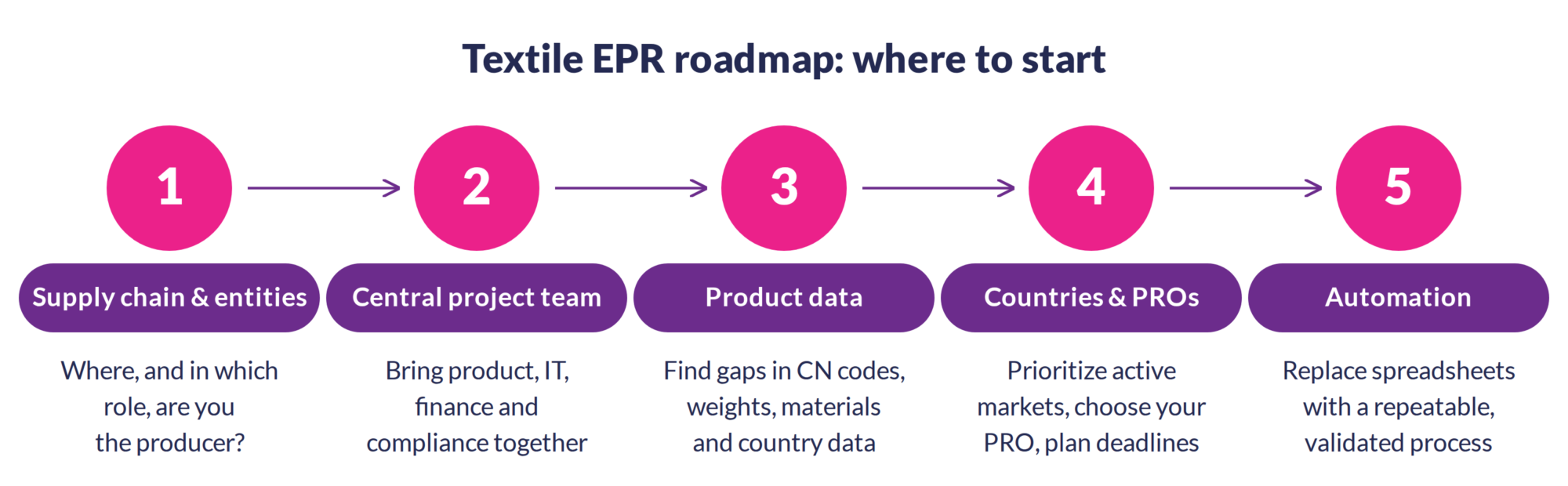
Step 1: Assess your supply chain and legal entities
Before looking at national legislation or reporting portals, start with your own organization. Your Textile EPR obligations depend on your role in the supply chain, and that role can differ per country.
One organization can be the manufacturer in one country, the importer in another and a distance seller in a third. One group-wide assumption is therefore not enough.
- Legal entities: Which entity within your group places the products on each national market?
- Supply chain role: In which countries are you the first party to make Clothing, Linen & Footwear (CLF) products available on the market?
- Sales channels: Which wholesale, retail and e-commerce flows do you have, and in which countries?
PRACTICAL LESSON 1 First determine where and in which role you are the producer.
Only then can you determine what you need to register and report.
Not sure how your supply chain position affects your producer status? We explain this in Part 2 of our Textile EPR series: Textile EPR producer: when are you considered a producer?
Step 2: Set up a central, cross-functional project team
Decentralized compliance is one of the most common pitfalls. When local offices or individual departments arrange registrations on their own, the result is fragmented data, duplicated work and limited central oversight.
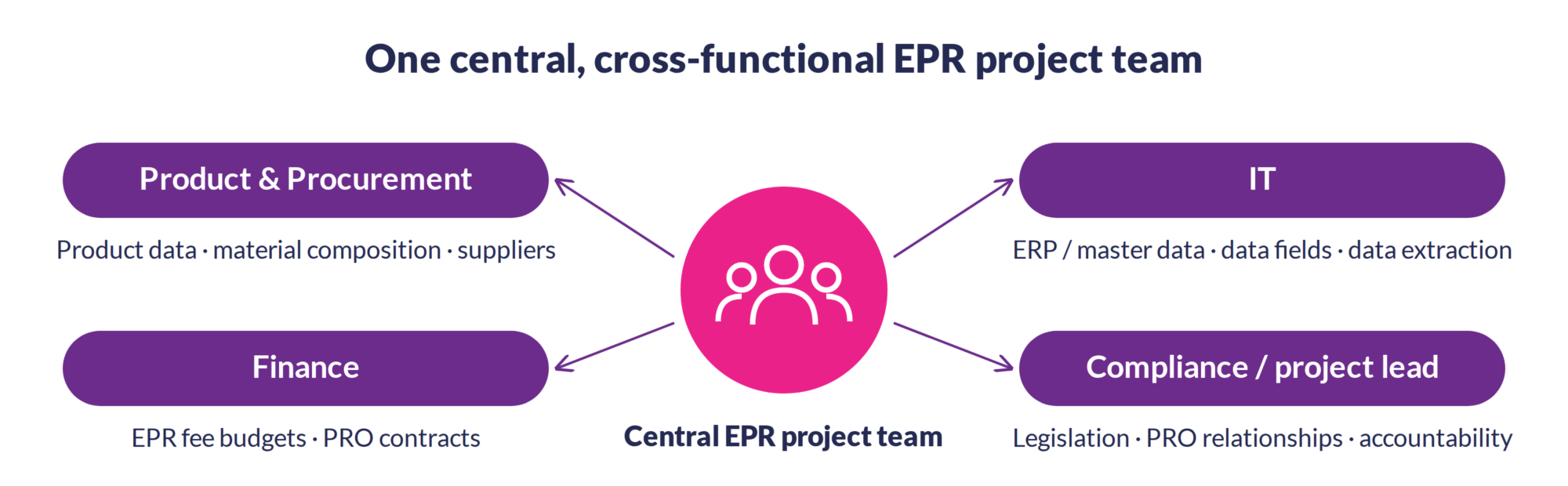
Build one central project team that brings the right expertise together:
- Product & Procurement: product data, material composition (such as fiber percentages or metallic fibers) and supplier information.
- IT: ERP or master data systems, data fields and automated data extraction.
- Finance: budgets for EPR fees and the financial side of PRO contracts.
- Compliance / project lead: monitoring legislation, managing PRO relationships and owning overall accountability.
We explain why a fragmented approach causes problems in Part 1: Textile EPR implementation: 3 common pitfalls organizations should avoid.
Step 3: Assess your product data and identify gaps
Once you know where you have obligations, check whether your systems hold the data you need. Textile EPR reporting requires a level of detail comparable to the PPWR, as we explained in Part 4: Textile EPR and the PPWR: which compliance obligations apply to you?
Run a data-gap assessment on your active product portfolio. Four questions help you get started:
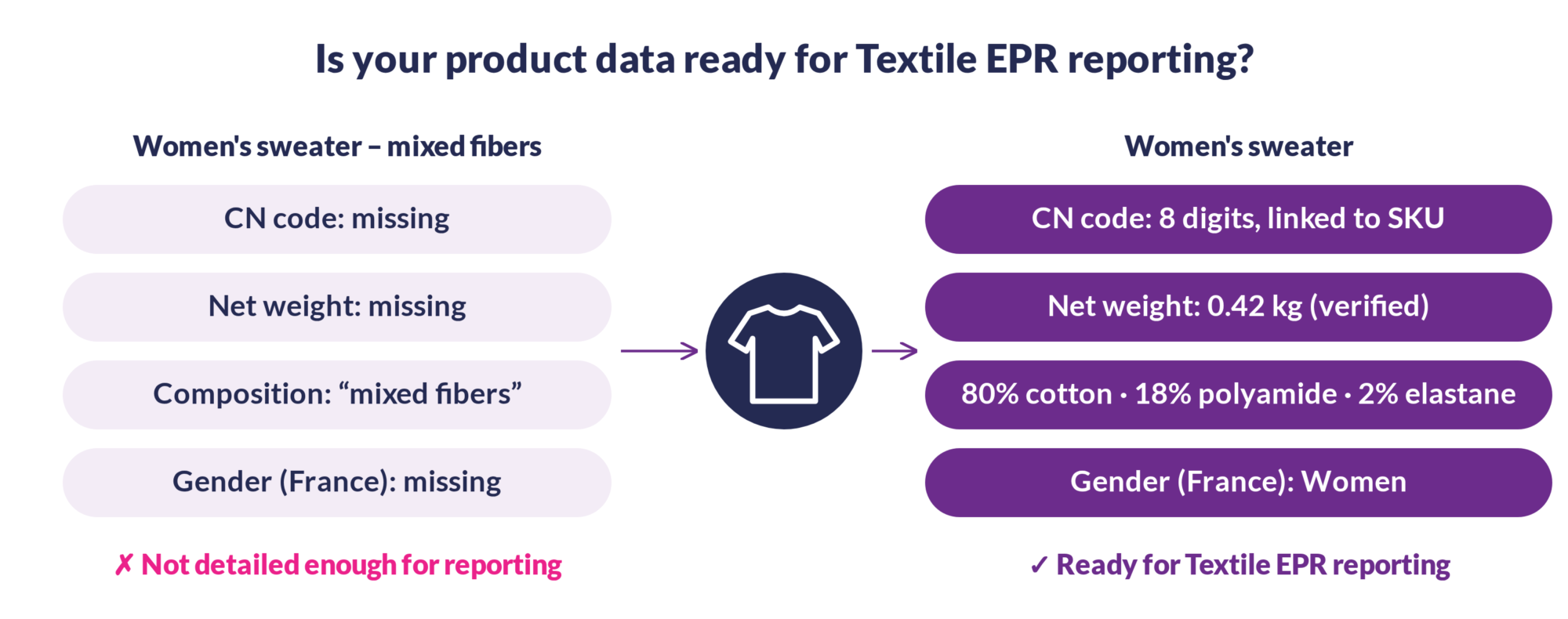
- CN codes: Are the 8-digit commodity codes of your products correct, and are they linked to each SKU?
- Weights: Do you have verified net weights per product? Accurate weights help you avoid over- or underreporting.
- Material composition: Can your system store a percentage breakdown, such as 80% cotton, 18% polyamide and 2% elastane?
- Country-specific data: Do you have the additional data some Member States require, such as the intended gender in France?
If your system only holds a general description such as "Women's sweater – mixed fibers", your data is not yet detailed enough for Textile EPR reporting.
PRACTICAL LESSON 2 Know what data you have and what is missing.
Run the gap assessment on your active product portfolio before reporting starts.
Step 4: Map country requirements and register with PROs
The EU framework is the same everywhere, but national requirements differ. Textile EPR is already active in France, Hungary, Latvia and the Netherlands, and final drafts are progressing in Denmark, Italy and Spain.
Base your priorities on where you are the producer and where requirements already apply:
- Start with active markets: Arrange your registrations first in countries where Textile EPR is already active or about to apply.
- Choose the right PRO: A Producer Responsibility Organization (PRO) organizes EPR activities on behalf of producers. Compare local PROs on fees, reporting portals and administrative support, and check whether you need an Authorized Representative as a foreign entity.
- Plan your reporting deadlines: Align your reporting schedules, whether monthly, quarterly or annual, so your declarations are submitted on time.
For an overview of the current status per country, read Part 3: Textile EPR Europe: which countries have implemented textile EPR?
Step 5: Move from spreadsheets to an automated process
Managing reporting for multiple countries manually in spreadsheets is hard to scale and carries risk.
As national legislation develops, reporting templates change, eco-modulation fee structures shift and submission windows can become tighter. If you map thousands of SKUs to changing PRO templates by hand every period, the risk of errors, overpaid fees or non-compliance increases.
An automated process connects your ERP data to the reporting requirements of each country. Your data is validated before submission, and a central audit trail shows how every report was built.
PRACTICAL LESSON 3 Build a repeatable process, not a new spreadsheet for every country.
One data foundation can serve multiple countries and reporting periods.
What can Pincvision do for you?
Implementing Textile EPR across multiple countries requires regulatory knowledge, reliable data and a structured process. You do not have to build all of that yourself.
- Obligation mapping: We analyze your legal entities, supply chain and sales flows to determine where, when and how Textile EPR applies to your organization.
- Data management and reporting: In our automated reporting system, we help collect, structure and enrich your product and sales data. We identify gaps and translate your data into the formats each country and PRO requires.
- Registration and reporting: From environmental registrations to recurring multi-country reporting and monitoring legislation, we handle the execution so your team can stay focused on its core business.
This gives you one centralized approach to Clothing, Linen & Footwear (CLF) compliance across Europe. It also creates a solid foundation for other Extended Producer Responsibility streams, such as packaging (PPWR), WEEE and Batteries.
Unsure where your organization should start with Textile EPR? Get in touch. We'll help you map your obligations and take the first steps toward compliant reporting. ⬇️
 4 min
4 min
Michelle Myburgh
Environmental Compliance Specialist


