+31(0)884321800
 en
en
 nl
nl


Prepare for mandatory UAE eInvoicing starting in 2027
The UAE is introducing mandatory eInvoicing in phases from 2027. Organizations in scope must exchange structured electronic invoices through Accredited Service Providers (ASPs), with relevant invoice data reported to the Federal Tax Authority (FTA).
For international organizations, preparing for the mandate involves more than establishing an ASP connection. You need to:
Assess scope → Prepare data & ERP → Implement invoice flows → Manage daily transactions
Pincvision can support this entire process. With NORA, our cloud-based global eInvoicing and eReporting platform, combined with implementation support, automated data validations and specialist VAT and eInvoicing expertise, we help you move from preparation to compliant daily processing within one scalable setup. See how Pincvision supports the process ↓
Already have part of your setup in place? Our approach is flexible. We can also support specific parts of your eInvoicing process, depending on your existing resources and requirements.
UAE eInvoicing at a glance
✔️ Mandatory implementation starts 1 January 2027 for businesses ≥ AED 50 million
✔️ Other businesses in scope follow 1 July 2027
✔️ Accredited Service Provider (ASP) required
✔️ Structured XML invoices based on PINT-AE
✔️ Peppol-based five-corner exchange model, with FTA involved
✔️ B2B, B2G, G2B and G2G transactions in scope
✔️ B2C transactions and certain others currently excluded
✔️ Scope isn't determined by VAT registration alone. Foreign VAT registrations also in scope
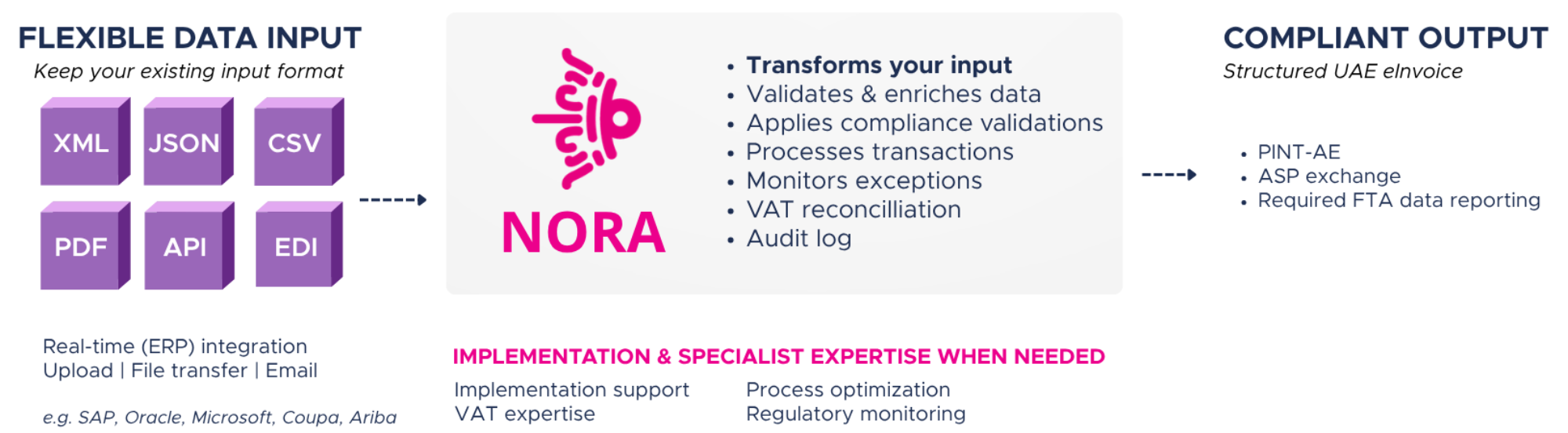
A successful UAE eInvoicing setup needs to work both on the mandatory go-live date and every day afterwards. We support international organizations across the complete electronic invoicing process:
- Scope and VAT analysis: determine affected entities, transactions and scenarios.
- Data readiness: assess source data, VAT treatment and system requirements.
- Implementation and testing: establish integrations and test end-to-end invoice flows.
- Automated processing and validation: process and validate transactions through NORA.
- Exception management: give your team visibility into errors and exceptions so they can be resolved efficiently.
- Ongoing specialist support: access our VAT and eInvoicing specialists when regulatory or operational questions arise.
One setup from implementation to daily compliant processing.
Need support with only part of this process? We can adapt the scope to your existing setup and internal capabilities.
UAE eInvoicing deadlines: when must your organization comply?
The UAE is introducing eInvoicing in phases based on annual revenue.

For organizations in the first phase, the period between the ASP appointment deadline and mandatory implementation is short. Data preparation, system changes, integration and testing therefore need to start before the ASP appointment date.
Which organizations and transactions are in scope?
The UAE eInvoicing mandate covers several types of business and government transactions.
In scope:
- Business-to-business (B2B)
- Business-to-government (B2G)
- Government-to-business (G2B)
- Government-to-government (G2G)
Currently excluded: B2C transactions and certain other transactions.
Importantly, scope is not determined solely by VAT registration. International organizations therefore need to assess their legal entities, business activities and transaction flows to determine where the mandate applies. This becomes particularly important for multinational organizations with multiple entities, VAT registrations and cross-border transaction flows.
How UAE eInvoicing works
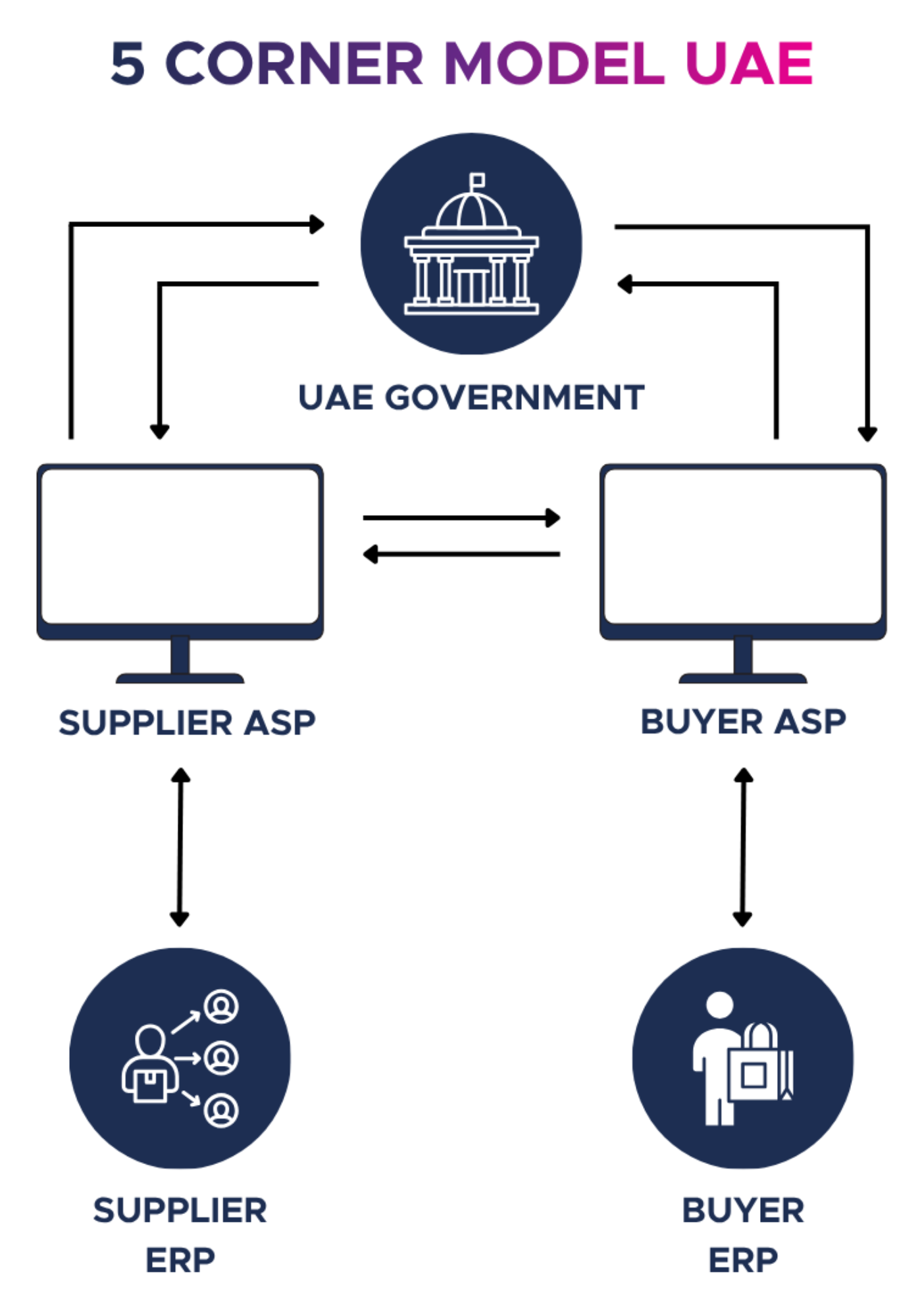
The UAE uses a decentralized five-corner model. Suppliers and customers exchange structured invoices through Accredited Service Providers. Relevant invoice data is also transmitted to the Federal Tax Authority (FTA).
For your organization, this means your ERP and invoice processes need to provide the correct structured data, connect with the required eInvoicing infrastructure and handle invoice statuses, validations and exceptions throughout the transaction lifecycle.
A PDF is not a compliant UAE eInvoice, but it can be your input
Under the UAE requirements, invoices must be exchanged as structured data based on the PINT-AE specification. A PDF, scanned document or invoice sent by email does not by itself meet the mandatory eInvoicing requirements.
That does not necessarily mean you need to change the format generated by your existing systems. NORA accepts different input formats, including PDF, XML, JSON, CSV, API and EDI, and transforms the data into the structured format required for compliant eInvoicing.
Compliance starts with your data, not your ASP connection
Selecting an Accredited Service Provider is important, but connectivity alone does not make your invoice process compliant. Before implementation you need to know whether:
- mandatory invoice and master data is complete
- VAT treatment is correctly reflected in your data
- ERP systems can provide the required information
- relevant business scenarios are correctly mapped and validated
Poor source data or incomplete mapping can result in validation errors, exceptions and manual rework after go-live.
This is why data validation is built into Pincvision's approach. During implementation, we help identify and resolve data issues before they become recurring operational problems. Once live, NORA continues to validate transactions and provides information on exceptions, along with practical explanations of how to solve errors yourself.
Manage daily UAE eInvoicing with NORA
Once live, NORA becomes the central environment for your ongoing eInvoicing (and eReporting) transactions. It processes and validates transactions, monitors statuses and gives your team visibility into exceptions that require attention.
Simple errors can be investigated using actionable information in NORA. Where structural issues occur, Pincvision can help identify the underlying cause and optimize the process to prevent recurring exceptions.
And because NORA supports multiple countries, your UAE setup can become part of the same environment used for other eInvoicing and eReporting mandates.

One setup for the UAE and future eInvoicing and eReporting mandates
For international organizations, the UAE is rarely the only eInvoicing mandate on the roadmap. Country requirements differ, but creating a separate technical solution and operating model for every mandate adds complexity.
NORA supports multiple eInvoicing and eReporting requirements from one centralized environment, allowing you to reuse integrations and processes while accommodating country-specific requirements.
Start preparing for UAE eInvoicing
Whether you are assessing scope, preparing your data, selecting an ASP or already implementing UAE eInvoicing, we can help determine the right next step.
Discuss your UAE setup
Talk through your scope, data or implementation approach with one of our UAE eInvoicing specialists.
See NORA in action
See how NORA automates and manages international eInvoicing and eReporting.

FAQ
When does UAE eInvoicing become mandatory?
UAE eInvoicing will be introduced in phases from 2027. Businesses with annual revenue of AED 50 million or more must comply from 1 January 2027. Businesses below this threshold follow from 1 July 2027, while UAE government entities follow from 1 October 2027.
Which businesses need to comply with UAE eInvoicing?
The mandate applies broadly to businesses conducting in-scope transactions in the UAE. Scope is not determined by VAT registration alone, so international organizations should assess their entities, activities and transaction flows individually.
Does my organization need an Accredited Service Provider?
Yes. Organizations subject to UAE eInvoicing must appoint an Accredited Service Provider (ASP) to exchange structured eInvoices through the UAE eInvoicing model.
Can we continue using our existing invoice input format?
Yes, when using NORA you can continue providing data in supported formats such as PDF, XML, JSON, CSV, API or EDI. NORA transforms the input into the structured format required for compliant UAE eInvoicing, so your source format does not have to be PINT-AE.
Can Pincvision also process our eInvoicing transactions only, or do we need the full-service solution?
Yes, that's possible. The scope is flexible: if you only need automated eInvoicing transaction processing, Pincvision can provide this through NORA without the additional specialist services. Implementation support, data validations and specialist expertise can be added where needed.