 +31(0)884321800
 en
 nl


Same weight ≠ same EPR fee
What is eco-modulation?
Traditionally, EPR fees are based on the weight or the number of products you place on the market. The Waste Framework Directive (WFD) and the EU's aim for a circular economy are changing that. Compliance is becoming more detailed.
Eco-modulation is a financial incentive for producers to develop more environmentally friendly products. The goal is to increase recyclability and limit the negative impact on the environment. This is usually done by setting requirements for the product or its packaging.
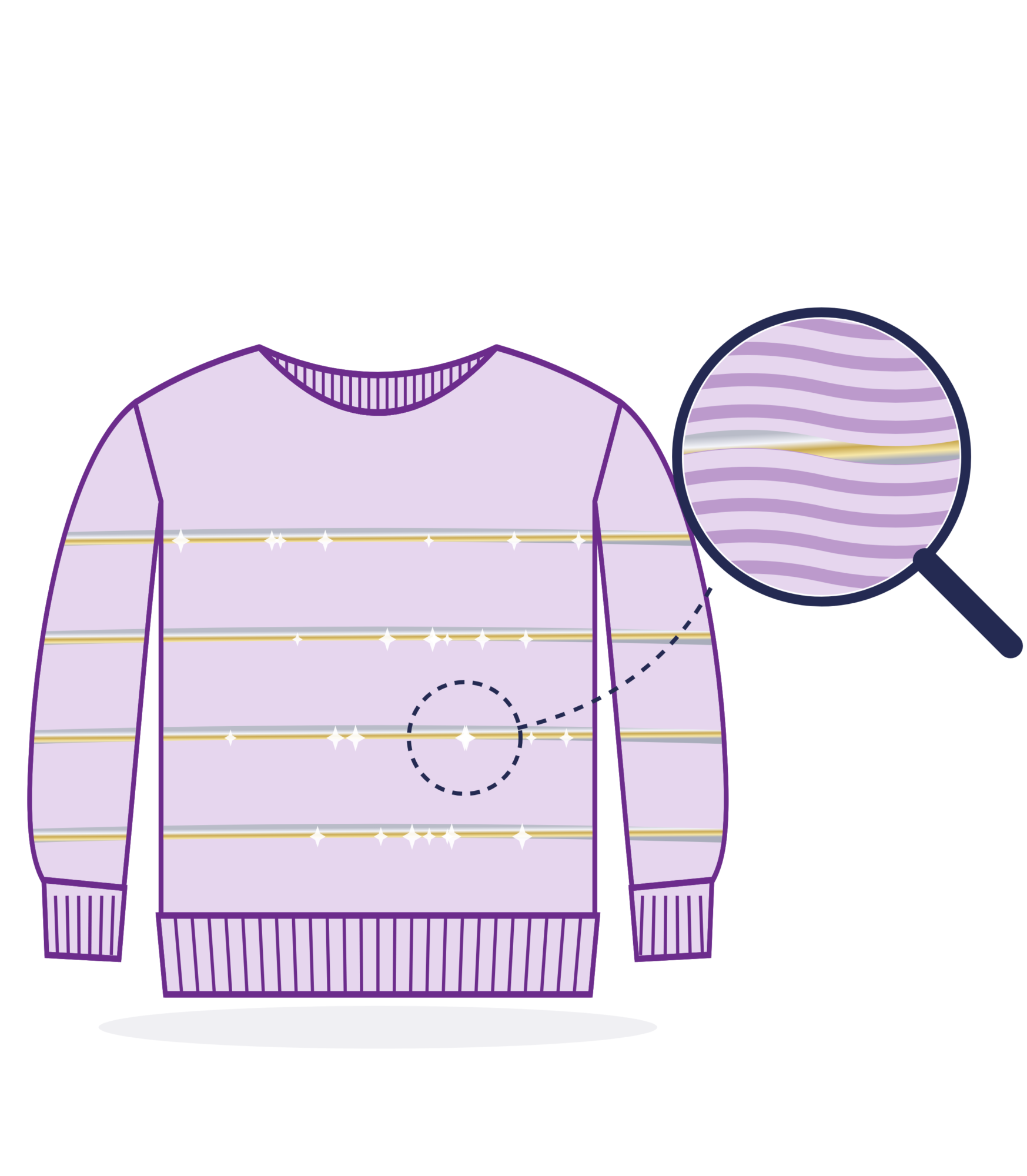
A TEXTILE EXAMPLE
Items that contain metallic fibers are not considered environmentally friendly, because these fibers make recycling more difficult.
How does eco-modulation affect your organization?
Eco-modulation affects your organization in two ways:
- Financial: the fee you pay per product.
- Product design: the choices you make in materials and composition.
The financial impact depends on the product, its recyclability, the country and the EPR stream it falls under. Think of textiles, but also packaging, WEEE and Batteries. Depending on the requirements, a product is reported against the baseline fee, or it receives a bonus or a malus:
- Bonus (lower fee): products designed for high recyclability, durability or reuse can qualify for a reduced EPR fee.
- Malus (higher fee): products made with materials that hinder recycling or harm the environment can face a higher EPR fee.
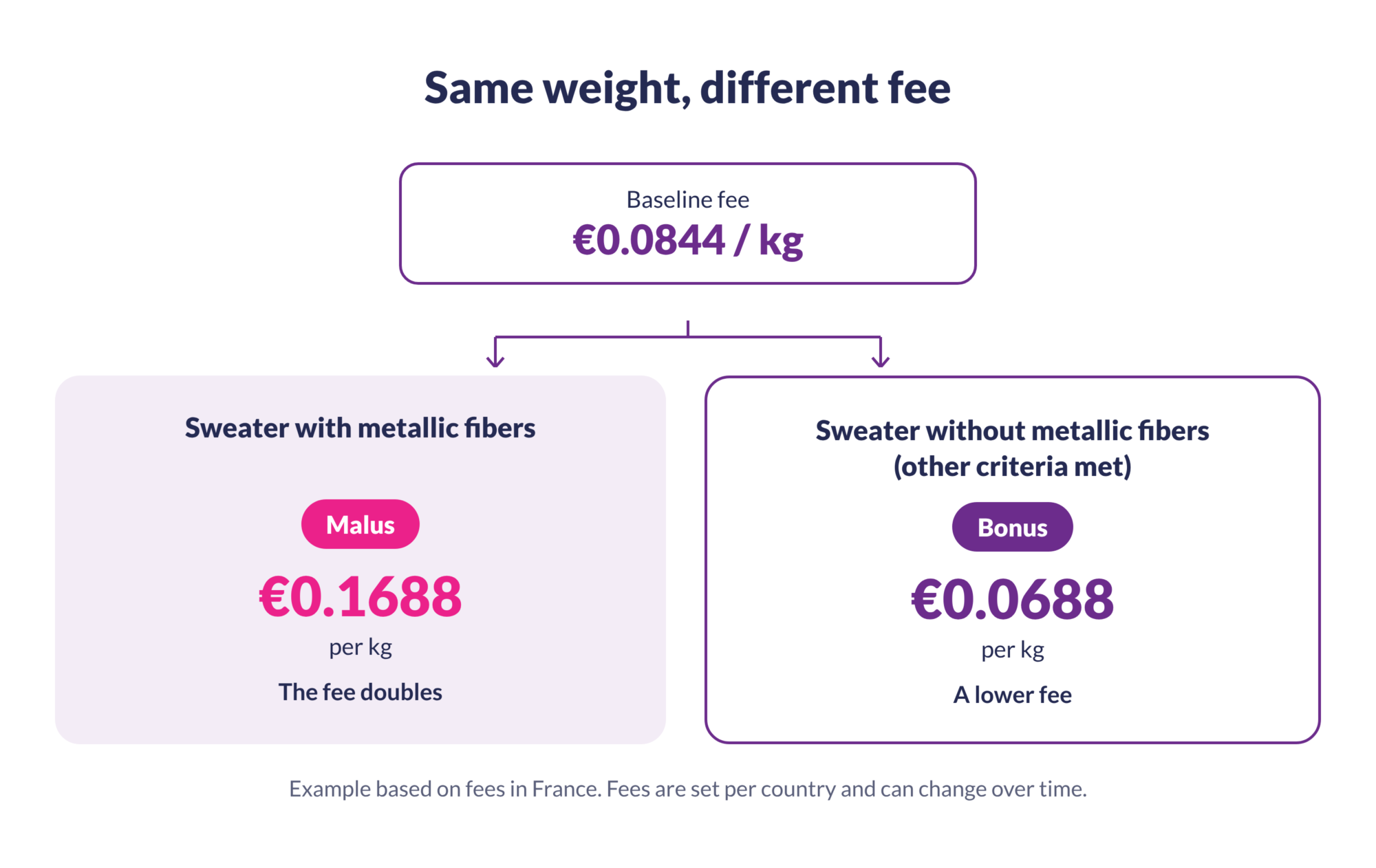
Example: a sweater on the French market
Product | Baseline fee (€/kg) | Eco-modulation | Fee after eco-modulation (€/kg) |
|---|---|---|---|
Sweater with metallic fibers | €0.0844 | Malus | €0.1688 |
Sweater without metallic fibers (other criteria met) | €0.0844 | Bonus | €0.0688 |
In this example, the malus doubles the fee. Depending on your product range and volumes, the financial impact of eco-modulation can be significant.
PRACTICAL LESSON
Product design is your main lever. The way to limit the impact of eco-modulation is to design products that meet the criteria.
What do you need to estimate the impact?
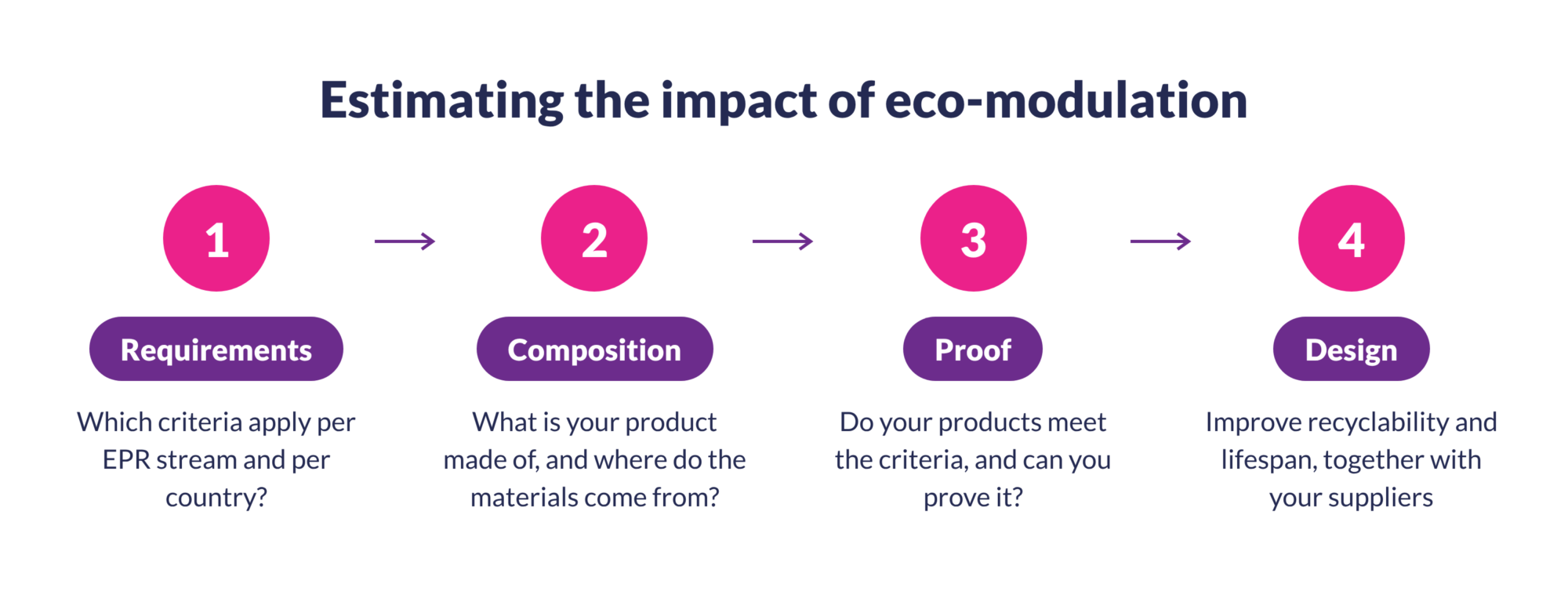
The answer sounds simple: product design. In practice, it requires more nuance. Adjusting a product requires collaboration within your organization and with your suppliers, whether they supply raw materials or finished products. As with every EPR obligation, data is key. To estimate the total impact of eco-modulation, you need insight into:
- Requirements: which eco-modulation criteria apply per EPR stream and per country?
- Composition: what is your product made of, which materials are used and where do they come from?
- Proof: do your products currently meet the criteria, and do you have the evidence to show it?
In Part 1 of our Textile EPR series: Textile EPR implementation: 3 common pitfalls organizations should avoid, we explain why it pays to perform a data-gap assessment early. With insight into your products and the requirements that apply, you can explore options to improve the recyclability and lifespan of the items you place on the market.
What can your organization do now?
Bring the right people together. With eco-modulation, a central, cross-functional team becomes even more important. Product design, procurement, compliance and your suppliers all influence the fee you pay. In Part 5 of our Textile EPR series: Textile EPR roadmap: where should your organization start?, we explain how to set up such a team.
When your team works together on data, product composition, eco-modulation criteria and possible design changes, new opportunities arise. You can create a positive impact at product level, both for the environment and for your compliance costs. Taking these steps early gives your organization time to adjust products before higher fees start to add up.
What can Pincvision do for you?
We help you understand which eco-modulation requirements apply to your products and what they mean for your costs:
- We determine which eco-modulation requirements apply to your organization, per country and per EPR stream.
- Together with your product data, we create a compliance roadmap to reduce your compliance costs and the negative impact on the environment.
- We support you with data management, reporting and compliance execution.
This gives you one centralized approach to Clothing, Linen & Footwear (CLF) compliance, without having to build all the regulatory knowledge internally.
Unsure how eco-modulation affects your Textile EPR costs? Get in touch. We'll help you map the requirements for your products and where you can reduce your fees.
 3 min
Roos Mijnen
Environmental Compliance Specialist


